
The Wrong Turn franchise has historically focused on the Odet family of inbred cannibals living in the remote Appalachian wilderness, but the latest installment, Wrong Turn (2021) flips the script with a totally new group of antagonists, The Foundation. Taking place in the Virginia Appalachian Trail, the movie continues the traps and brutal kills of its predecessors, but the antagonists of the film, The Foundation, are markedly different from the Odets.
The Wrong Turn franchise is well-known for its cannibalistic backwoods family, a group of villains that play on the traditional stereotypes associated with Appalachian mountain folk and more broadly, hillbillies and people from the American South in general. The group is an isolated inbred family of brutal killers who set traps in the remote Appalachian forest to kill adventurous hikers and unsuspecting interlopers for food and sport.
Wrong Turn is far from being the only movie to use the killer hillbilly as the villain in their story, nor the first, with Deliverance and The Texas Chainsaw Massacre being two of the most famous examples. However, with the latest Wrong Turn installment in 2021, the movies shift focus away from cannibals and inbreeding to a different kind of isolated Appalachian society.
Introducing The Foundation

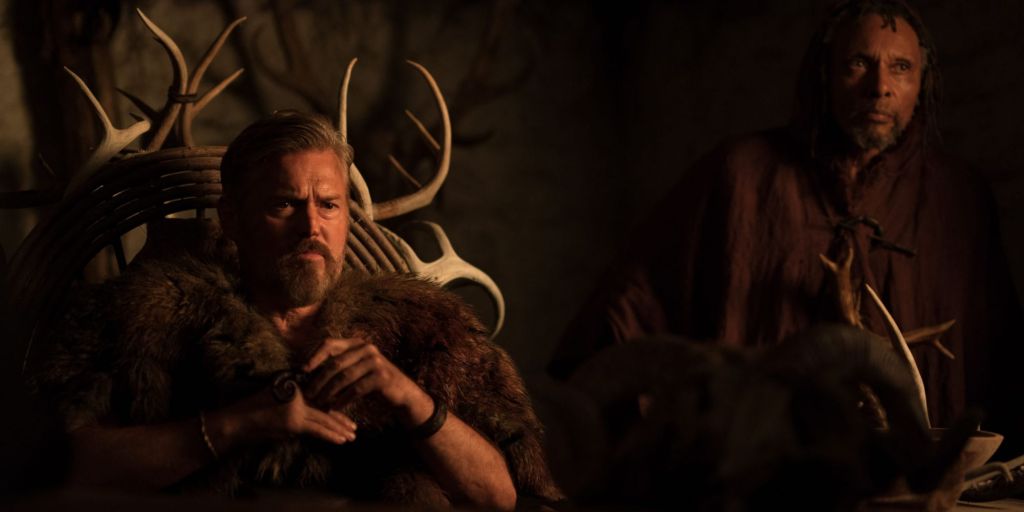
A reboot of the franchise that brings back Alan McElroy, the original writer from Wrong Turn (2003), Wrong Turn (2021) introduces a primitive luddite community living deep and isolated in the West Virginia forest. Known as The Foundation, the group dates back to families who fled society before the American Civil War, wanting to preserve their way of life in the face of what they believed to be an oncoming societal collapse.
While the movie originally presents The Foundation as a misunderstood community of isolationists who welcome people of all races and creeds to live together sharing their skills and labor equally amongst the group, the rest of the film reveals that the dynamics of the group may be a bit more gray than all black and white.
The brutal traps set by the antagonists are the main through-line that connects the 2021 reboot to the original series aside from the setting of the remote Appalachian mountains, though The Foundation seems to use their traps more as a way to keep out intruders and defend their way of life than to hunt and kill people for food. That’s what they say, anyway. As the movie goes on, it becomes increasingly unclear whether their killer traps are merely self-defense, and might instead just be a brutal attack on anyone who ventures too close to their village regardless of the intentions of the person caught by the trap.
Another major difference between the Odet family and The Foundation is that these new villains do not seem to be cannibals. Though it’s not explicitly seen what is done with the bodies of the dead, there’s no implication that cannibalism is a part of their lifestyle. This is seen in the way that they punish people with “darkness,” leaving them alive to slowly starve to death with no eyes or tongue. If they were using people for food, it’s likely that they wouldn’t let these people live, and would simply kill them to keep in meat storage.
However, while the type of brutality that The Foundation engages in is remarkably different than that of the cannibalistic Odet family, that doesn’t make their actions any less brutal. Punishment by darkness, deadly tripwires and log fall traps, and [SPOILERS] the way the group hunts down the escaped protagonist, poses as new neighbors to infiltrate her home, and fully intends to kill her entire family in order to get her back if she won’t go willingly [END SPOILERS] all indicate that The Foundation is more than capable of intense violence outside from what’s necessary for simple self-preservation.
Subverting Cinematic Depictions of Appalachian Peoples
The thing about Wrong Turn 2021’s premise that’s quite unique both in the franchise and the sub-genre of Appalachian horror is that it creates a unique dynamic between the protagonists, the townspeople, and The Foundation that distinctly highlights both the positive and negative attributes of all of these groups without painting any of them as wholly good or evil. Every group gets the same nuanced treatment, with multifaceted characters and realistic motivations, depicting them all as complete human beings rather than flat representations of a specific archetypes.
At the beginning of the film, the movie sets things up to trick the audience into a false sense of security. The story opens with Jen’s father looking for in her after she’s gone missing, the Sheriff makes some disparaging comments about young college girls and then is racist about her having a black boyfriend. We’ve heard all this before; bigoted small town people in the South don’t care about these college kids and leave them to fend for themselves against the murderous mountain folk.
This is further reinforced with the encounter Jen and her friends have with the locals in the bar, when several men approach them asking if they need a guide up the mountain. The kids act a bit dickish, and the locals respond in kind with the type of things that you would expect them to say, but that’s where things change. Jen stands up to them and mentions that they are hard workers, people who have done a lot to get themselves where they are and are smart, capable people trying really hard in the world. She also mentions the yellowing of the local man’s eyes, something she’s familiar with because of Milla studying to be a nurse. The man backs away angrily, but leaves them be after that.
This is where we’re going to have to get into some serious spoiler territory, so if you don’t want spoilers, stop here!
Later, when Jen’s father Scott visits the same bar looking for information about his daughter, we see him encounter the same group of men, and they react with similar anger. Initially, they simply tell him to stay away from the woods and to not go looking for his daughter – she’s long gone – but when he seems intent on going forward with his hiking expedition they later accost him next to his car, beating him up and giving him a black eye.
This is all rather expected, right? Small-town rednecks are bigoted and angry about any newcomers, want to keep the status quo, so they attack anyone trying to upset the balance or make waves. However, it’s revealed later when Jen and Scott have nearly escaped The Foundation that these men were simply trying to protect Scott from the inevitable danger he would face if he ventured into the woods alone. The group of locals shows up to help rescue Jen and Scott, telling her that he’s thankful for their interaction, that the yellowing of his eyes turned out to be serious, but the doctor caught it early because of her warning. He also says that he lost a nephew to The Foundation years ago, and has simply been trying to keep anyone else from meeting the same fate.
We see a similar subversion of tropes with The Foundation themselves once we meet them. Outwardly in our first interactions with the group, they wear animal skulls, gillie suits made of brush and twigs, and a variety of natural materials that keep them camouflaged when they’re out in the woods. However, once the protagonist group is brought back to stand trial for Adam’s mistakenly killing one of their members, the group is revealed to be far from uncivilized “savages.”
The Foundation aren’t cannibals, they’re not inbred, and they’re not unreasonable. They simply want justice for the murder of one of their own, and they intend to carry out a trial by jury, allowing the perpetrators to defend themselves before being sentenced. Of course, after this initial interaction, The Foundation’s way of life turns out to be a bit more grey than it is black and white, but they certainly aren’t the pure evil savage hillbilly murders that the Wrong Turn name makes us assume they will be.
In movies like Deliverance, Texas Chainsaw Massacre, The Hills Have Eyes, Motel Hell, and all the other “killer hillbilly” horror movies out there, there are expectations set up for what type of people The Foundation and the local townsfolk in this movie have to be in order to be effective villains. There’s a precedent that they have to be ignorant, uneducated, crazy, cannibalistic, incestuous, etc., and in many ways this is the same brush that people from the American South are painted with in the eyes of the American public.
However, not only does Wrong Turn subvert these traditional archetypes, but it proves that people of the Appalachian mountains can be villains or heroes, and they can do so both outside and inside of the type of faces and personalities we expect to find from that area. A Southern accent or Appalachian dialect doesn’t make someone ignorant or incapable of compassion, and a remote mountain community doesn’t mean cannibals and incest, and this is a super important distinction to be made for an area and heritage of people who are largely looked down on by most outsiders.
People from all walks of life can be good or bad, and it doesn’t have anything to do with where they come from or how they talk.






 Jackalope House of Horrors